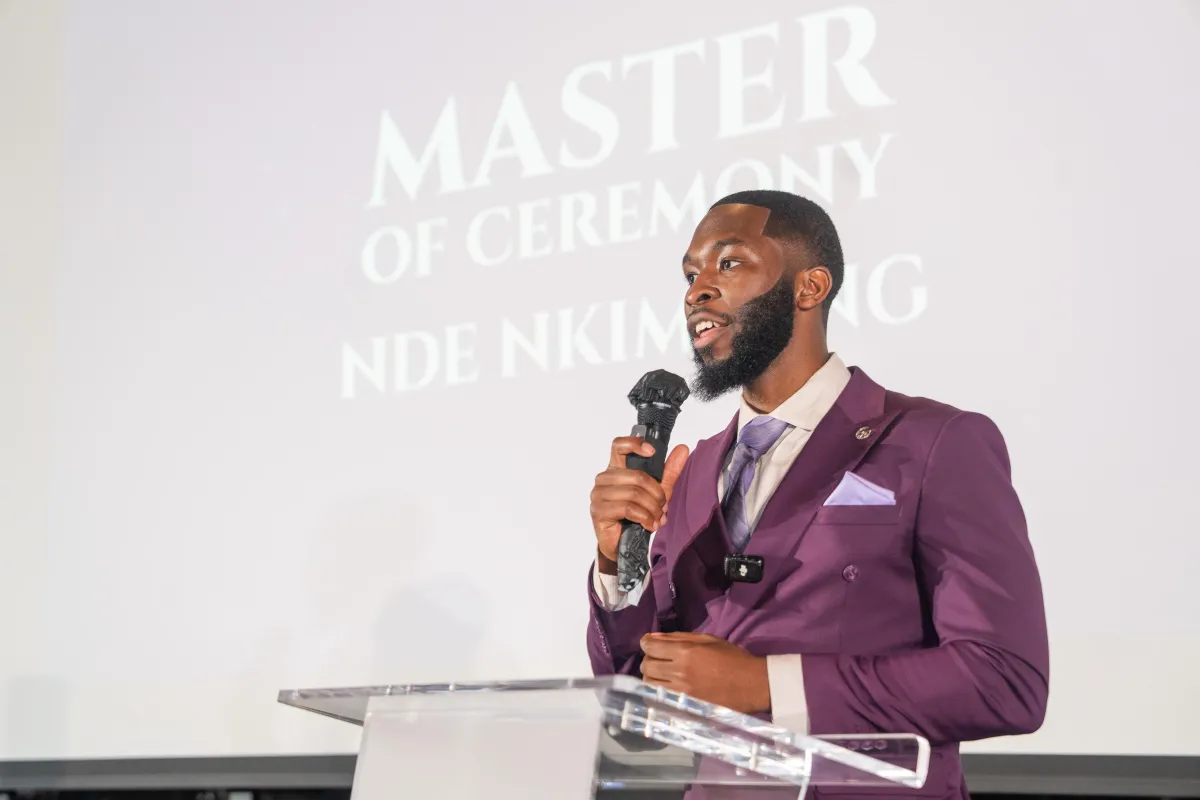
What Your Emcee Needs From Your Run of Show (A Planner's Checklist From 250+ Events)
“Your run of show isn’t paperwork. It’s the difference between a great night and thirty-five minutes of silence.” — Nde Nkimbeng, The Engineer MC
The 35 Minutes That Weren’t in the Run of Show
A healthcare company hired me to host their 10-year anniversary. 200 people in the room. Big night for them.
The run of show had a video playing right before the CEO’s keynote. Company history, milestones, the whole arc. It was built to set up his speech.
The video rolled. No sound.
Nobody could tell me how long the fix would take. Not five minutes, not thirty. Nobody knew. And I had 200 people watching me find out in real time.
I bought 35 minutes.
Here’s what I did. I pulled one representative from every table and ran a best dressed competition. Round one was everybody. Round two cut it to three. Then I put those three in a dance battle.
By the time the audio came back, the room was on its feet.
That segment was nowhere in the run of show. It became one of the most memorable parts of the night.
Why That Worked — And Why It Wasn’t Improvisation
Here’s the part people get wrong when they hear that story.
They think I improvised. I didn’t.
I could pull a representative from every table because those representatives already existed. Earlier that evening, during the opening, I ran an activity that named a table captain at every table. Small thing. Thirty seconds of housekeeping dressed up as fun. It set the tone and got people talking to the strangers they were seated next to.
It also meant that two hours later, when the room went quiet, I had twenty people I could call on by name instead of scanning a crowd of 200 for volunteers.
The mechanism was already in the room. I just used it.
That’s the difference between a host who thinks fast and a host who built the thing that lets them think fast. You cannot build that on the night. You build it when you read the run of show.
I always say: an emcee’s best save is the one they set up two hours earlier.
What Your Emcee Actually Needs From You
Most planners send their emcee an agenda. An agenda tells me what happens. It doesn’t tell me what to do when it doesn’t.
Here is the checklist I ask every client for. Steal it. Send it to whoever you hire.
| What to send | Why your emcee needs it | What breaks without it |
|---|---|---|
| Timings with durations — not just start times | Durations show what’s elastic and what’s fixed | When you fall behind, nobody knows which segment to compress. So you compress the wrong one. |
| Every name, spelled phonetically, with the title they want used | Names get said out loud, from a stage, once | A mispronounced honoree is the fastest way to lose a room’s trust — and it is unrecoverable. |
| Who is actually in the audience — roles, seniority, why they came | It decides the register: how technical, how warm, how much to push | You get generic energy aimed at a generic room. |
| AV and lighting cues, and who calls them | Your emcee and your AV lead have to be reading the same document | Two people cue the same moment, or nobody does. |
| Anything that must be said word for word — sponsor thank-yous, legal, safety | These are non-negotiable and usually get remembered last | A sponsor who paid for a mention doesn’t get one. |
| The three things the night must achieve | If everything else falls apart, these are what your emcee protects | Your host optimizes for the schedule instead of for your outcome. |
| Your soft spots — the speaker who always runs long, the video nobody has tested | So a plan exists before the problem does | Your emcee finds out at the same moment your audience does. |
| One name and one phone number for during the show | Decisions have to get made in seconds, not by committee | Dead air while three people decide who decides. |
That last one matters more than it looks. Every save I’ve ever made started with knowing who I was allowed to ask.
When to Send It
Two weeks out is ideal. That gives me time to research your speakers, learn the names, and rehearse the transitions instead of reading them for the first time backstage.
But two weeks is my floor, not my preference.
What I’d rather do is be in it while you’re building it. Not receive the run of show. Help build it.
Because that document is where the attendee experience actually gets designed. Where the energy peaks sit. Where you need a laugh before a heavy segment. Where the room needs to stand up and move before you ask them to sit through a twenty-minute keynote. Where a table captain gets created two hours before anyone knows why.
All of that gets decided in the document, weeks before a single guest walks in.
I traded blueprints for microphones, but the job didn’t change. I’m an event experience engineer. The run of show is the drawing.
The Framework Behind All of This: T.E.C.H.
This is the first time I’ve put this in writing publicly.
Every event I host runs through four things. I call it T.E.C.H.
- T — Tailored Experiences
- E — Edutaining Energy
- C — Creative Flow
- H — High Impact Results
The run of show is where Tailored Experiences gets built. Everything custom about your night — the callback to your founder’s first office, the table captains, the moment you didn’t know you needed — comes out of that document and the conversations around it.
Send an agenda the day before and you get a competent host reading names off a page.
Bring someone in while you’re building it and you get a night designed around your people.
What It Looks Like When It Goes Right
I hosted the NSBE DFW Celestial Soirée Scholarship Gala. Before that night I did the work — the organization, the honorees, and why those scholarships mattered to the people receiving them.
Here’s what Jessica Thomas, P.E., President of NSBE DFW, said afterward:
“Nde was an absolutely amazing Emcee for the NSBE DFW Celestial Soirée Scholarship Gala! From the moment he stepped on stage, his high energy was infectious and truly set the perfect tone for the entire evening… What truly set Nde apart was the clear effort he put into his role. He took the time to conduct deep research, which allowed him to bring incredible personalization to his speeches.”
Notice what she credited. She mentioned the energy. But what she said set me apart was the research. The preparation. The part that happened weeks before I picked up a microphone.
That’s the argument of this entire post, made better than I could make it by someone who paid for it.
The Short Version
- Send timings with durations, not just start times.
- Phonetic spellings for every name. Every one.
- Tell your emcee where the risk is. They cannot cover for a problem you hid.
- Give them one name and one number for the night.
- Two weeks out, minimum.
- Better: bring them in while you’re still building it.
250+ events across 7 countries. The ones that go sideways are almost always the ones where the host found out what was happening at the same time the audience did.
That is a preventable problem. It gets prevented in a document, two weeks early.
Planning an event?
If you want a host who reads your run of show before he reads your room — and who helps build it with you — let’s talk.
Hosting a conference or summit? Here’s how I work with conference teams. Or text me directly at 978-398-5422 — I respond within the hour.
